Equipment Instructions
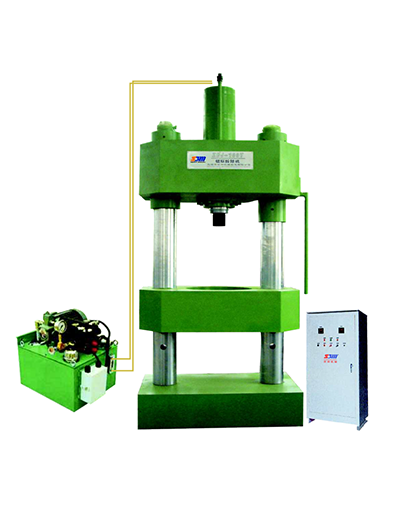
A Four-Column Three-Beam Hydraulic Press (also called Three-Beam Four-column Hydraulic Press) is a classic heavy-duty forming machine, featuring a rigid frame of three horizontal beams (upper crossbeam, sliding beam/slider, lower crossbeam/worktable) and four vertical columns, widely used in metalworking and composite material forming.
Core Structure & Components
Frame System: Upper beam (mounts the main cylinder), slider/middle beam (moves vertically along columns), lower beam/worktable (fixed base). Four high-strength columns with pre-tensioned nuts form a closed rigid frame for uniform force distribution and minimal deflection.
Hydraulic System: Motor-driven high-pressure pump, cartridge valve integrated circuit, oil tank, pressure/flow control valves. Can achieve constant pressure, fixed stroke, pressure holding and delay functions.
Electrical Control: PLC+touch screen, with manual, semi-automatic and automatic modes; safety devices include light curtains, emergency stops, overload protection.
Optional Accessories: Ejection cylinder (for part stripping/stretching pad), heating plate, servo drive, precision positioning sensors.
Working Principle
Based on Pascal's law, the motor drives the pump to generate high-pressure oil, which pushes the main cylinder piston to drive the slider down along the four-column guide rail. It completes processes such as stamping, stretching, bending, and pressing. After the process is completed, the reversing valve changes the oil flow direction to realize the slider's return; the pressure, speed, and stroke can all be precisely adjusted.
Key Performance & Technical Features
High rigidity, good guiding accuracy, suitable for high-precision forming;
Wide tonnage range (from dozens of tons to thousands of tons);
Energy-saving options: servo-hydraulic system reduces power consumption by 30%~60%, lower noise and heat generation;
Strong versatility, easy to match with various molds and auxiliary equipment.
Typical Applications
Metal Processing: Sheet metal stretching, bending, flanging, cold extrusion, stamping, calibration, press-fitting;
Non-Metal Forming: Powder metallurgy parts, composite materials, rubber/plastic products, ceramic forming;
Other Industries: Automobile chassis/body parts, kitchenware, electrical enclosures, railway accessories, etc.
Common Models & Selection Considerations
Common standard models include Y32/YL32 series. When selecting, focus on:
Nominal pressure (tonnage), slider stroke, opening height, table size;
Required process (stretching requires an ejection cylinder, precision forming requires servo control);
Production efficiency, energy consumption budget, safety level;
After-sales service and spare parts supply.
Maintenance Highlights
Regularly check and replace hydraulic oil and filters to prevent oil contamination;
Maintain the guide rail and column lubrication, check the sealing of the cylinder to avoid leakage;
Calibrate pressure sensors and position switches regularly;
Strictly follow the operating procedures to avoid overloading and improper operation leading to equipment damage.
Key technical parameters :
| Mode | Type | Capacity | Stroke | Daylight | ||||
| Power | Working pressure | Work-piece Size | Work-piece Movement Mode | |||||
| ZBJ-G-100 | 380V50Hz | 31.5mpa | 100T | 700mm | 800mm | ≤700×700×700 | ||
| Double-column | Manual Movement | |||||||
| ZBJ-G-250 | 380V50Hz | 31.5mpa | 250T | 900mm | 1000mm | ≤900×900×900 | ||
| Four-column | Hydraulic Movement |
 RELATED
 RELATED
 RELATED
 RELATED

Company Address:
Add:No. 7, Hengtong Road, Yangshan Industrial Zone, Huishan District, Wuxi City
Email:info@wxsbjx.com
Contact person: Manager Zhou
Tel:+86-510-85596218


Copyright © 2026 Wuxi Shibang Machinery Manufacturing Co., Ltd.
SitemapThis website uses cookies to ensure you get the best experience on our website.

 Español
 Portugues
 Pусский
 Français
 العربية



 WhatsApp
 Phone
Phone